Tel:0411-87935556
E-mail:dlpinhong@163.com
Address:No. 1, building 8, Hongxing Industrial Park, Dalian Economic and Technological Development Zone, Dalian
Freeze drying technology, as an advanced food processing method, can preserve the nutritional components, color, and flavor of food to the maximum extent possible, while extending the shelf life. Choosing a suitable food freeze dryer is crucial for food production enterprises, laboratories, or household users.
1、 Core performance parameters
1. Freeze dried area
The freeze-drying area directly determines the amount of food processed in a single operation and is a key indicator for measuring equipment capacity. Household models typically have an area of 0.1-0.5 square meters, small commercial machines have an area of 0.5-2 square meters, and industrial grade equipment can reach an area of 5-50 square meters or larger. When selecting, the demand should be calculated based on the daily processing capacity, and a margin of about 20% should be reserved.
2. Limit the vacuum degree
The vacuum degree directly affects the freeze-drying effect, usually expressed in Pa (pascals) or mbar (millibars). Excellent food freeze-drying machines should be able to reach below 10Pa, and high-end models can reach 1-5Pa. The higher the vacuum degree, the faster the moisture sublimation, and the higher the freeze-drying efficiency. Attention should be paid to the type of vacuum pump (oil pump vs dry pump) and its maintenance requirements.
3. Condenser temperature
The condenser temperature determines the ability to capture water vapor, generally requiring a temperature below -40 ℃, and excellent equipment can reach -50 ℃ to -80 ℃. The lower the temperature, the higher the water capture efficiency, especially for foods with high water content. Attention should also be paid to the material of the condenser (stainless steel is preferred) and the defrosting method.
4. Temperature control range
The freeze-drying process is divided into three stages: pre freezing, sublimation, and analytical drying, each with different temperature requirements. Excellent equipment should have a wide temperature range control capability from -50 ℃ to+80 ℃, with a temperature control accuracy within ± 1 ℃. The segmented programming function can set better freeze-drying curves for different foods.
2、 Structural design parameters
1. Shelf material and design
Food grade stainless steel (such as 304 or 316L) is a better choice, and the surface should be smooth and easy to clean. The shelf spacing can be adjusted (usually 5-10cm) to accommodate products of different heights. The heating shelf should ensure temperature uniformity (within ± 2 ℃), and some equipment also has weight monitoring function.
2. Structure of drying chamber
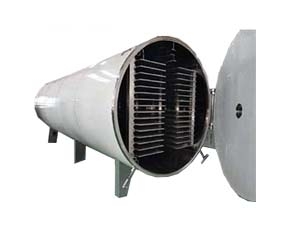
The warehouse body should be made of high-strength stainless steel, and the observation window design should facilitate process monitoring. The sealing system adopts low-temperature resistant materials such as fluororubber to ensure long-term use without aging. The design of warehouse doors should consider operational convenience and sealing, and industrial equipment should also comply with pressure vessel standards.
3. Vacuum system configuration
Including vacuum pumps, vacuum gauges, and valves. Rotary oil pumps are suitable for most applications, while dry pumps are easy to maintain but expensive. It is recommended to equip the vacuum gauge with a Pirani gauge and a capacitive composite vacuum gauge to ensure accurate measurement across the entire range. Valves should be selected from high-quality products that are corrosion-resistant and leak free.
3、 Function and control parameters
1. Control system
Modern freeze dryers often use PLC or touch screen control and should have the following functions:
Multi segment program storage (at least 10 sets or more)
Real time curve display and data recording
Fault self diagnosis and alarm function
Remote monitoring interface (USB/Ethernet, etc.)
Password protection and permission management
2. Security protection function
A comprehensive protection system should include:
Vacuum degree too high/low pressure alarm
Compressor overload protection
High temperature protection for condenser
Abnormal power protection
The door is not tightly closed and interlocked
3. Energy consumption and efficiency indicators
Pay attention to the energy consumption per unit freeze-drying area (kW · h/kg), and efficient equipment should have:
Variable frequency compressor regulation
Heat recovery system
Intelligent defrosting control
Standby low-power mode
4、 Applicability parameters
1. Food adaptability
The requirements for freeze-drying process vary greatly among different foods, and the equipment should be able to handle:
Liquid food (juice, soup): rotating or spray device is required
Solid food (fruits, vegetables, meat): shelf load-bearing capacity ≥ 50kg/m ²
Viscous materials: special trays or pre-treatment functions
2. Production capacity calculation
The actual production capacity is affected by various factors, and the calculation formula is:
Daily production (kg)=freeze-drying area (m ²) × loading capacity per unit area (kg/m ²) × 24-hour/freeze-drying cycle (h)
For example, with a 2m ² equipment, a loading capacity of 10kg/m ², and a cycle of 20h, the daily output is approximately 24kg
3. Auxiliary functions
Based on the requirements:
CIP online cleaning system
Aseptic nitrogen filling packaging interface
Multi warehouse parallel capability
Automatic loading and unloading device
5、 Service and Certification
1. Qualification certification
Ensure that the equipment complies with:
CE/UL Electrical Safety Certification
FDA Food Contact Material Certification
ISO9001 Quality Management System
Pressure vessel certification (such as ASME)
2. After sales service
Key investigation:
Warranty period (usually 1-3 years)
Spare parts supply capability
Technical support response time
Operation training content
3. Scalability
Consider possible future scenarios:
Capacity upgrade plan
Process improvement space
Intelligent docking capability
Purchase suggestions
Clear priority of requirements: laboratory emphasizes accurate control, production emphasizes efficiency and cost, and household emphasizes convenience and safety.
Field investigation: Observe the actual performance of equipment operation noise, vibration, sealing, etc.
Sample testing: Provide actual materials for small-scale freeze-drying tests.
Full lifecycle cost: In addition to the purchase price, long-term expenses such as energy consumption, maintenance, and labor are calculated.
Industry reputation: Refer to the real usage evaluations of similar users.
By systematically evaluating the above parameters and combining them with one's own budget and actual needs, one can select food freeze-drying equipment with better cost-effectiveness, providing reliable guarantees for product quality and production efficiency.
130 8413 3386
Tel:0411-87935556
E-mail:dlpinhong@163.com
Address:No. 1, building 8, Hongxing Industrial Park, Dalian Economic and Technological Development Zone, Dalian

More highlights are waiting for you