Tel:0411-87935556
E-mail:dlpinhong@163.com
Address:No. 1, building 8, Hongxing Industrial Park, Dalian Economic and Technological Development Zone, Dalian
Discussion on Strategies for Reducing Energy Consumption and Cost in Pharmaceutical Freeze Dryers
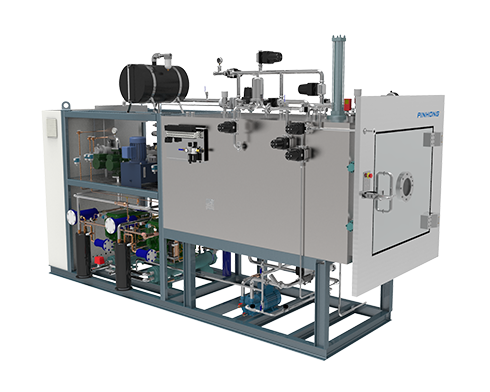
Pharmaceutical freeze dryers are core equipment for the production of freeze-dried preparations in the pharmaceutical industry. Their energy consumption accounts for 20%–40% of the production cost of preparations, making them a critical link in enterprise cost control. With intensified competition in the pharmaceutical industry and rising requirements for green manufacturing, reducing the energy consumption of freeze dryers while ensuring product quality has become an urgent issue for enterprises. Based on the working principle of freeze dryers and industrial practices, this paper discusses energy-saving strategies from multiple dimensions.
The core energy consumption of freeze dryers lies in the refrigeration, vacuum and heating systems, and the rationality of selection and design directly determines the baseline energy consumption.
High-efficiency refrigeration systems: Replace traditional piston compressors with variable-frequency screw compressors, which increase the coefficient of performance (COP) by more than 20%; adopt a two-stage refrigeration cycle (high-temperature stage for condenser heat dissipation and low-temperature stage for freeze-drying chamber refrigeration) to reduce energy consumption in the low-temperature section.
Energy-saving vacuum systems: Use a combination of Roots pumps and rotary vane pumps. Roots pumps provide a large pumping speed in the high-vacuum stage, while rotary vane pumps operate only during startup, reducing energy consumption by 30% compared with single rotary vane pumps; oil-free and high-efficiency screw vacuum pumps consume 15%–20% less energy than conventional pumps.
Enhanced thermal insulation performance: The freeze-drying chamber adopts composite insulation of polyurethane foaming plus vacuum insulation panels (VIP), with a thermal conductivity of only 0.004 W/(m·K) to minimize cold loss; optimize door sealing design to prevent vacuum leakage.
Optimized shelf design: Use high-thermal-conductivity aluminum alloy shelves to increase contact area; design a uniform liquid distribution system to ensure even heat transfer and shorten freeze-drying time.
Pre-freezing is the foundation of freeze-drying, and optimized pretreatment can significantly reduce subsequent sublimation time.
Control of material concentration and loading volume: Maintain concentration at 10%–20% to avoid prolonged processing due to over-dilution or uneven heat transfer due to over-concentration; control the loading thickness at 5–15 mm, as excessive thickness increases sublimation resistance.
Optimization of pre-freezing processes: Slow pre-freezing (0.5–1℃/min) for heat-sensitive materials and rapid pre-freezing (2–5℃/min) for non-heat-sensitive materials; set the pre-freezing temperature 5–10℃ below the eutectic point to avoid energy waste from excessive pre-freezing.
Improved pre-freezing methods: Liquid nitrogen pre-freezing achieves a rate of over 10℃/min, shortening pre-freezing time by 30%; contact pre-freezing enables direct heat transfer through shelves with high efficiency.
Freeze-drying consists of sublimation and desorption stages, and dynamic parameter adjustment balances efficiency and energy consumption.
Sublimation stage: Control shelf temperature 1–2℃ below the eutectic point and vacuum at 10–30 Pa to ensure sublimation rate without increasing vacuum pump load; monitor material temperature in real time and dynamically adjust refrigeration/heating power.
Desorption stage: Gradually increase shelf temperature (30–50℃) and lower vacuum (1–5 Pa) to accelerate removal of residual moisture; avoid excessive temperature that causes material denaturation.
Intelligent control systems: Adopt PLC/DCS systems integrated with sensors to collect real-time parameters and automatically adjust equipment operation, reducing energy waste.
Regular maintenance is key to sustaining energy-saving performance.
Condenser cleaning: Defrost (via hot gas or electric heating) after each batch to prevent frost buildup from reducing refrigeration efficiency.
Vacuum pump maintenance: Replace oil every 3–6 months and inspect seals for leaks to reduce no-load operation.
Production scheduling optimization: Arrange batches rationally to avoid equipment idling; fully load the freeze-drying chamber in each batch to improve utilization.
Operator training: Standardize operating procedures to prevent energy increase caused by misoperations (e.g., premature heating, inappropriate vacuum levels).
Waste heat recovery: Recover condenser heat for shelf heating or workshop heating; use residual heat of freeze-dried materials to preheat the next batch.
Application of new technologies: Low-temperature heat pumps achieve a COP of over 4 and recover waste heat for heating; freeze-drying simulation software (e.g., COMSOL) optimizes process parameters to reduce experimental energy consumption; continuous freeze-drying technology increases equipment utilization by 50% and reduces energy consumption per unit product by 20%–30%.
Reducing energy consumption of pharmaceutical freeze dryers requires multi-dimensional coordination. Under the premise of complying with GMP regulations, the above strategies can reduce energy consumption by 15%–30%, significantly cutting costs and promoting the transformation of the pharmaceutical industry toward green manufacturing. This not only enhances enterprise competitiveness but also aligns with the requirements of sustainable development.
130 8413 3386
Tel:0411-87935556
E-mail:dlpinhong@163.com
Address:No. 1, building 8, Hongxing Industrial Park, Dalian Economic and Technological Development Zone, Dalian

More highlights are waiting for you